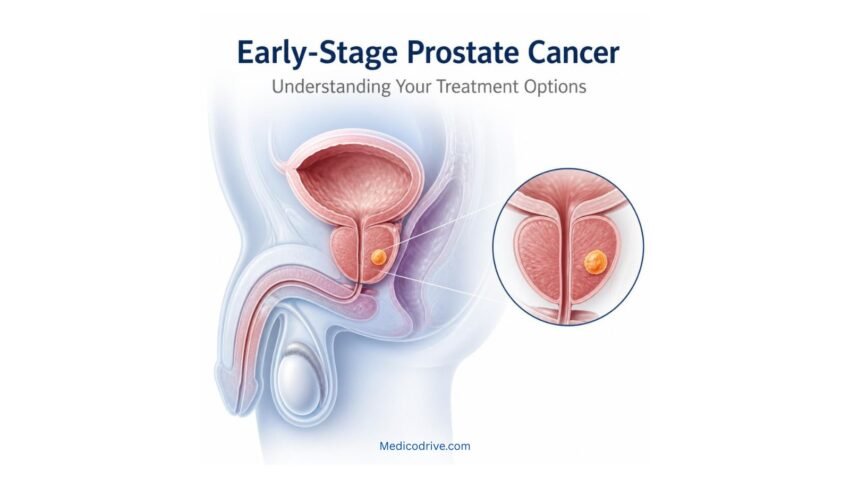
If you have just been told that you have early stage prostate cancer, there is a good chance that your first question is very simple: “Doctor, what is the best treatment?” And I understand why you want a straightforward answer. When you hear the word cancer, your natural reaction may be to think that it needs to be removed as quickly as possible. But with early prostate cancer, things are not always that simple. There isn’t one treatment that is best for every man. In some men, the safest and most sensible approach may actually be to monitor the cancer rather than treat it immediately. In others, treatment with surgery or radiation may be the better choice.
The decision depends on what kind of prostate cancer you have, how likely it is to grow, your general health and life expectancy, and also what matters most to you when it comes to the possible side effects of treatment. So before you start comparing surgery with radiation, let’s take one step back.
First, what does “early-stage” prostate cancer actually mean?
Early-stage prostate cancer generally means that the cancer has been found before it has spread to distant parts of the body. But that doesn’t mean every early prostate cancer behaves in the same way. This is something I would want every newly diagnosed patient to understand.
Two men can both be told that they have “early-stage prostate cancer” and still have very different cancers. One may have a slow-growing cancer that is unlikely to cause problems for many years. Another may have features suggesting that the cancer is more likely to grow and spread. That is why your doctor doesn’t decide on treatment based on the word cancer alone.
You may hear your doctor mention your PSA, Gleason score, Grade Group, MRI or biopsy report. If those words are unfamiliar, don’t worry. You don’t need to understand a pathology textbook to understand what is happening. Think of these tests as pieces of a puzzle. Your doctor is putting them together to answer a much more important question:
“How dangerous is this particular cancer, and what is the risk of leaving it untreated?”
Your PSA is a blood test that gives information about the prostate. Your biopsy tells doctors whether cancer is present and provides information about how abnormal the cancer cells look. The MRI can provide additional information about where the cancer is and how extensive it appears to be. Your doctor combines these findings with the stage of the cancer and your overall health before recommending a treatment.
Does every man with early prostate cancer need treatment immediately?
The Simple Answer is, NO.
This is probably one of the most surprising things for a newly diagnosed patient to hear. Some prostate cancers grow so slowly that treating them immediately may not provide enough benefit to justify the possible side effects of treatment. In these situations, your doctor may recommend something called active surveillance.
And I want to clarify what that means because the phrase can sound frightening. Active surveillance does not mean that your doctor has decided to ignore your cancer. It means that your cancer is being monitored closely, with the intention of starting treatment if there are signs that it is becoming more aggressive. Monitoring can involve PSA testing, examinations, MRI and sometimes repeat biopsies, depending on your individual situation.
So if your doctor recommends active surveillance, don’t interpret that as:
“There is nothing we can do.”
A better way to understand it is:
“At this point, the risks of immediate treatment may be greater than the benefit, so we are going to watch the cancer carefully and treat it if the situation changes.”
For men with very-low- or low-risk prostate cancer, active surveillance is commonly recommended because many of these cancers are unlikely to cause serious problems, while surgery and radiation can have long-term effects on quality of life.
But what if I don’t feel comfortable leaving cancer untreated?
That is completely understandable, some men find active surveillance reassuring because they want to avoid treatment unless it becomes necessary. Others find the idea extremely stressful. They may spend every few months worrying about their PSA or wondering whether the cancer has changed.
There isn’t a psychological “right” answer here. Your doctor has to consider the medical risk of your cancer, but you also have to consider how you feel about the uncertainty of surveillance. For some men, treating the cancer provides peace of mind even when surveillance is medically reasonable. For others, avoiding unnecessary treatment and its possible side effects is much more important. And that conversation is part of the treatment decision.
If I need treatment, is surgery the best option?
Surgery is one of the established treatments for localized prostate cancer. The operation, called a Radical Prostatectomy, involves removing the prostate gland and usually the seminal vesicles. Depending on the cancer and the circumstances, nearby lymph nodes may also be removed. For a suitable patient, surgery can be a curative treatment. But there is something I would tell a patient before making this decision:
Don’t think only about what happens to the cancer. Think about what happens to you after treatment.
Prostate surgery can affect urinary control and sexual function. The severity and likelihood of these problems vary from person to person, and your baseline health and sexual and urinary function matter when discussing the risks. For some men, these risks are acceptable because they strongly prefer surgical removal of the prostate. For others, avoiding or minimizing these particular side effects may carry greater importance. That is why “surgery is the best treatment” is too simplistic an answer.
What about radiation therapy?
Radiation is another established treatment for localized prostate cancer, instead of removing the prostate, radiation uses high-energy radiation to destroy cancer cells. Depending on the situation, treatment may involve external-beam radiation or brachytherapy, in which radioactive material is placed inside or near the prostate.
Radiation can be used as a definitive treatment for appropriately selected localized prostate cancers, and for some higher-risk cancers it may be combined with hormone therapy. But radiation has its own possible side effects. Urinary symptoms, bowel problems and sexual problems can occur, although the likelihood and severity vary between patients and treatment techniques. So again, the question isn’t simply:
“Is radiation better than surgery?”
The more useful question is:
“Which option gives me appropriate cancer control while fitting my health, my cancer characteristics and my priorities?”
What about newer treatments like HIFU and focal therapy?
You may come across newer treatments such as HIFU or other focal therapies while researching prostate cancer. They can sound very attractive because the idea is to destroy the cancer while potentially treating less of the prostate. But I would be cautious about assuming that a newer treatment is automatically a better treatment.
Some newer approaches are still being studied, and long-term evidence may not be as mature as it is for established treatments such as surgery and radiation. The American Cancer Society notes that most expert groups do not generally recommend focal therapies such as cryotherapy or HIFU as a first treatment for low-risk disease when established options are available, largely because of limitations in long-term evidence. That doesn’t mean these treatments have no role.
It means you should ask a very simple question:
“How much do we actually know about the long-term results compared with established treatments?”
So which treatment has the highest chance of curing early prostate cancer?
This is where I would be careful with the word “best.”
For some men with very-low- or low-risk disease, immediate treatment may not be necessary at all, and active surveillance can be an appropriate strategy.
For men who need definitive treatment, surgery and radiation are both established options for localized prostate cancer. The appropriate choice depends on the cancer’s risk characteristics and the individual patient’s circumstances.
In other words, there isn’t a universal treatment that wins for everyone. Your doctor’s job isn’t simply to find the treatment that attacks the cancer most aggressively. It is to find the treatment strategy that makes sense for your particular cancer and your particular life.
Your age matters, but it isn’t the whole story
You may have heard someone say:
“You’re young, so you should have surgery.”
Or perhaps:
“You’re older, so you don’t need treatment.”
Neither statement is sufficient by itself. Age matters because doctors consider your expected lifespan and general health when deciding whether treatment is likely to provide a meaningful benefit.
A healthy 70-year-old and a 70-year-old with several serious medical conditions may have very different treatment considerations. Similarly, a younger man may have a cancer aggressive enough to require treatment, while another younger man may have genuinely low-risk disease that can reasonably be monitored. So don’t let your age alone determine the answer.
What I would ask my doctor before choosing treatment
If you are sitting in the consultation room and your mind is racing after hearing the diagnosis, you may forget half of what you wanted to ask. I would start with something simple:
“How aggressive is my cancer?”
Then ask your doctor to explain what your PSA, biopsy, Grade Group or Gleason score, MRI and stage actually mean in your case.
You can then ask:
“Am I a candidate for active surveillance?”
If the answer is no, ask:
“Why do you think I need treatment now?”
And if surgery and radiation are both options, don’t just ask which one the doctor prefers. Ask what the expected benefits and side effects are for you, and what would happen if the first treatment didn’t completely control the cancer. If possible, getting an opinion from both a urologist and a radiation oncologist can also help you understand the decision from different perspectives.
One last thing I want you to remember
Being diagnosed with early prostate cancer can make you feel as though you have to make a decision immediately. In many cases, you don’t. Take the time to understand what type of cancer you have, how aggressive it appears to be, whether active surveillance is a reasonable option, and what you might gain and potentially lose from each treatment.
Don’t choose a treatment simply because someone you know had it. And don’t choose a treatment simply because it is newer. Your prostate cancer is your cancer, and the right decision depends on details that cannot be determined from the word “early-stage” alone. If you have been given a PSA report, biopsy report or MRI result and don’t understand what it means, ask your doctor to walk you through it. A good treatment decision starts with understanding the disease you actually have not the disease you are afraid you might have.
This article is for general education and is not a substitute for an individualized consultation with a urologist, radiation oncologist, or other qualified cancer specialist. This Article is Medically reviewed by Dr Ashish Panwar.
References
- NCI: Prostate Cancer Treatment (PDQ) Read source
- American Cancer Society: Treatment by Stage & Risk Group Read source
- AUA/ASTRO: Clinically Localized Prostate Cancer Guideline (2026 update) Read guideline
- EAU: Prostate Cancer Guidelines Read guidelines

Hello, I am Dr. Ashish. I have lot of experience in medical field and education, I have gained lot of knowledge in my entrance exam life and medical studies which I want to share with everyone so that I can help more and more people.