The Jack Sparrow MCAT Anki deck is one of the most detailed community-made flashcard decks available for MCAT preparation. With approximately 6,301 cards, it covers Biology, Biochemistry, General Chemistry, Organic Chemistry, Physics, Psychology, and Sociology. Unlike shorter decks that focus mainly on quick fact recall, Jack Sparrow anki deck MCAT uses detailed question-and-answer cards that require students to explain concepts from memory.
But is a deck with more than 6,000 cards actually worth using? Is it better than MileDown or AnKing? And how do you use it without spending your entire day reviewing flashcards?
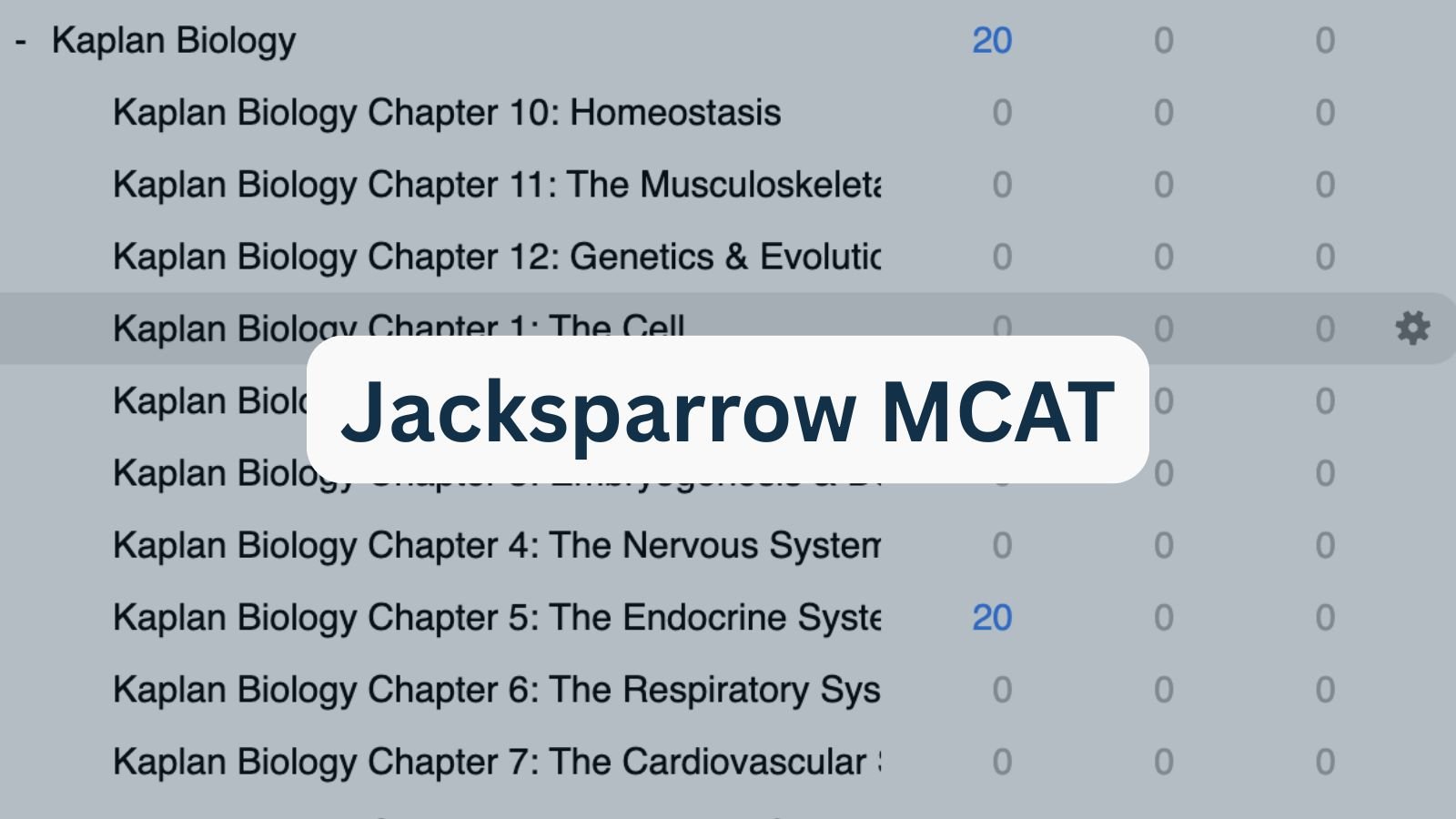
This guide covers the original download, card organization, subject coverage, Kaplan chapter tags, installation, daily card targets, and comparisons with other popular MCAT Anki decks. It also explains when Jack Sparrow Anki Deck makes sense and when a smaller deck may be a better choice.
Quick Overview: Jack Sparrow MCAT Anki Deck
| Feature | Details |
|---|---|
| Deck name | JackSparrow MCAT Anki Deck |
| Original creator | u/JackSparrow2048 |
| Approximate card count | 6,301 |
| Cost | Free original community release |
| Main format | Traditional question-and-answer |
| Biology | Included |
| Biochemistry | Included |
| General Chemistry | Included |
| Organic Chemistry | Included |
| Physics | Included |
| Psychology | Included |
| Sociology | Included |
| Content organization | Kaplan chapters and Khan Academy P/S sections |
| Best suited for | Detailed MCAT content review |
| Main drawback | Large workload and lengthy cards |
Our verdict: Jack Sparrow is a strong option for students who want detailed content recall rather than simply memorizing short definitions. Its biggest advantage is also its biggest disadvantage: the cards can demand a lot of time.
JackSparrow MCAT Anki Deck Download
If you want the original updated JackSparrow deck, use the creator’s original Reddit post and download rather than relying on random reuploaded files.
Original download resources:
The original creator shared an updated version in August 2020 after discovering that a commonly circulated tagged version did not include all the edits made to the original cards.
The updated release reorganized the science material around Kaplan chapters and the Psychology/Sociology material around Khan Academy document sections.
The creator listed approximately 6,301 cards for this version.
Important: This is the original updated community release, not a newly released official 2026 deck. If you find a file advertised as JackSparrow 2.0, check who created it and what was changed before assuming it is an official update.
What Makes the Jack Sparrow Deck Different?
The easiest way to understand Jack Sparrow is to compare the way its cards ask questions.
Consider two examples.
A shorter card:
Q: What is the rate-limiting enzyme of glycolysis?
A: Phosphofructokinase-1 (PFK-1).
A more detailed card:
Q: Explain the major regulatory steps of glycolysis.
A: Recall the key regulatory enzymes, their regulation, and the conditions affecting pathway activity.
These are different styles of active recall.
A short card tests a specific fact. A detailed card asks you to reconstruct a larger concept without relying on as many hints.
This is where Jack Sparrow Anki deck can be useful. If you can answer a detailed card without looking at the back, you have a better opportunity to identify exactly which parts of a topic you do not understand.
However, long cards also create a problem. You may remember most of an answer but struggle to decide whether you should mark the entire card correct.
For this reason, do not treat every long card as a test of perfect paragraph memorization. Focus on the important scientific relationships and the concepts being tested.
How Many Cards Are in the Jack Sparrow MCAT Deck?
The original updated release lists approximately 6,301 cards.
The creator shared these approximate subject totals:
| Subject group | Approximate cards |
|---|---|
| Biology and Biochemistry | 2,266 |
| Chemistry and Physics | 1,825 |
| Psychology and Sociology | 1,785 |
| Total listed subject groups | 5,876 |
| Other cards and collection differences | Varies |
These are reference figures, not a guarantee that every imported Anki collection will display precisely the same number.
You might see a slightly different total depending on the version, imported notes, duplicate handling, and how Anki displays notes versus cards.
If your collection does not show exactly 6,301, check the imported subdecks and subject sections before assuming something is missing.
Is 6,301 Cards Too Many for the MCAT?
It depends on your preparation timeline.
A student with six months can approach a large deck very differently from someone with six weeks remaining.
Here is how long it would take to introduce 6,301 new cards at different daily targets:
| New cards per day | Approximate days |
|---|---|
| 20 | 315 |
| 25 | 252 |
| 30 | 211 |
| 40 | 158 |
| 50 | 127 |
| 75 | 84 |
| 100 | 63 |
| 150 | 42 |
These calculations only cover new cards. They do not include the additional reviews generated by Anki’s spaced-repetition system.
That distinction matters. Introducing 100 new cards daily does not mean you will only have 100 cards to answer every day.
As your collection grows, previous cards return for review.
My recommendation: Do not choose your daily target simply because you want to finish all 6,301 cards. Choose a workload that leaves enough time for practice questions, CARS, and full-length exams.
JackSparrow MCAT Deck Subject Breakdown
1. Biology
Biology is one of the major sections of the JackSparrow collection.
The deck covers important areas of MCAT biology, including:
- Cell structure and function
- Cell membranes and transport
- Organ systems
- Genetics and inheritance
- DNA replication and gene expression
- Evolution
- Reproduction
- Development
- Experimental biology concepts
Biology is not a subject where memorizing isolated definitions is always enough. You also need to understand how biological processes connect.
For example, knowing the definition of an enzyme is useful, but understanding enzyme activity, regulation, and experimental conditions is much more valuable when solving passage-based questions.
2. Biochemistry
Biochemistry is another important reason students consider JackSparrow.
Relevant content includes:
- Amino acids and proteins
- Protein structure
- Enzyme kinetics
- Glycolysis
- Gluconeogenesis
- Citric acid cycle
- Oxidative phosphorylation
- Lipid metabolism
- Carbohydrate metabolism
- DNA and RNA processes
This section can be particularly useful if you find yourself forgetting pathways or mixing up biochemical processes.
One suggestion: learn the pathway first and then use Anki to recall the important enzymes, substrates, products, and regulatory steps.
Trying to memorize an unfamiliar pathway entirely through flashcards is not the most efficient approach.
3. General Chemistry
General Chemistry covers the foundational concepts required for MCAT Chemistry and Physics preparation.
Topics include:
- Atomic structure
- Periodic trends
- Chemical bonding
- Chemical reactions
- Stoichiometry
- Equilibrium
- Acids and bases
- Thermodynamics
- Electrochemistry
- Solutions
Do not rely exclusively on memorizing equations. Understand what the variables represent and when a particular relationship applies.
4. Organic Chemistry
The Organic Chemistry section covers concepts such as:
- Functional groups
- Isomers
- Stereochemistry
- Reaction mechanisms
- Nucleophiles and electrophiles
- Carbonyl chemistry
- Oxidation and reduction
- Separation and purification techniques
- Laboratory methods
Organic Chemistry questions often require you to recognize a reaction or interpret an experimental setup.
Flashcards can help with recognition and recall, but reaction-based practice is still necessary.
5. Physics
Physics includes important MCAT concepts such as:
- Kinematics
- Newton’s laws
- Work and energy
- Fluids
- Pressure
- Waves
- Sound
- Optics
- Electricity
- Magnetism
- Circuits
I would recommend keeping a separate formula sheet alongside your Anki reviews.
Knowing an equation is not the same as knowing how to apply it to a passage or numerical problem.
6. Psychology and Sociology
The Psychology/Sociology portion follows material associated with Khan Academy behavioral-science sections and the community’s detailed P/S study resources.
Topics include:
- Learning and conditioning
- Memory
- Cognition
- Sensation and perception
- Psychological disorders
- Personality
- Social interaction
- Social institutions
- Culture
- Demographics
- Research methods
- Sociological theories
P/S involves a considerable amount of terminology, so spaced repetition can be particularly useful.
However, be careful with similar terms. Understanding the distinction between two related psychological or sociological concepts is more useful than memorizing two isolated definitions.
JackSparrow vs MileDown vs AnKing vs Captain Hook
This is probably the most important comparison to make before downloading a deck.
All four options have their own strengths, and choosing the largest collection does not automatically mean choosing the best one.
| Deck | Approximate size | Main strength | Main limitation |
|---|---|---|---|
| JackSparrow | 6,301 | Detailed active recall | Lengthy cards |
| MileDown | 2,900 | Concise, manageable review | Less detailed |
| AnKing MCAT | Version-dependent, around 6,000+ | Organization and tagging | Large review workload |
| Captain Hook V2 | 7,002 | Reworked JackSparrow content plus additions | Still a large deck |
| Aidan | Version-dependent, around 12,000+ | Extensive coverage | Very time-consuming |
| Mr. Pankow | Around 2,254 | Dedicated P/S coverage | Not a complete MCAT deck |
Card counts are approximate community-reported figures. Different versions and imports can change the displayed total.
JackSparrow vs MileDown Anki Deck
JackSparrow and Mile Down Anki deck are built around different approaches.
MileDown Anki deck is more concise. Its cards are generally easier to move through quickly, making it a practical option for students who want Anki to support their content review without becoming the main activity of the day.
Jack Sparrow anki deck requires more detailed recall. If you regularly feel that shorter flashcards are not testing your understanding sufficiently, Jack Sparrow anki deck may be worth considering.
Choose Jack Sparrow anki deck if: You want deeper content recall and have sufficient time.
Choose Mile Down anki deck if: You prefer shorter cards and want a more manageable daily workload.
JackSparrow vs AnKing
AnKing is worth considering if you prefer a more structured deck with extensive tagging and organization.
JackSparrow is more closely associated with traditional question-and-answer recall and Kaplan chapter organization.
AnKing may be easier to manage if you like filtering cards by tags and using a more integrated collection.
JackSparrow may appeal more if you prefer its original detailed card style.
There is considerable overlap between popular MCAT decks. Completing both in full is rarely necessary.
JackSparrow vs Captain Hook
Captain Hook is particularly interesting because it builds on the JackSparrow approach.
The Captain Hook V2 community release includes rephrased JackSparrow-based science material, Mr. Pankow Psychology/Sociology cards, equations, and additional content.
The creator reported a total of approximately 7,002 cards.
Its aim is to preserve detailed coverage while improving the presentation and organization.
If you like JackSparrow’s content but dislike some of its formatting, Captain Hook is worth comparing.
Explore the Captain Hook V2 community release.
JackSparrow vs Aidan
Aidan is aimed at students who want extensive content coverage.
Its size can be a serious commitment, particularly if you are also completing question banks and full-length exams.
JackSparrow is already a large deck, but Aidan takes the comprehensive approach even further.
I would not recommend choosing Aidan simply because it contains more cards.
JackSparrow vs Mr. Pankow
These two decks are not direct replacements for each other.
JackSparrow covers the entire MCAT subject range, including Psychology and Sociology.
Mr. Pankow is a dedicated Psychology/Sociology resource.
If P/S is your weakest section, you may prefer using Mr. Pankow for that subject rather than relying entirely on the P/S portion of a general deck.
Avoid activating every overlapping card from both decks without a clear reason.
How to Install the JackSparrow MCAT Anki Deck
The installation process is straightforward, even if you have never used a premade Anki deck.
Step 1: Install Anki
Download Anki from its official website:
Install the desktop application and open it.
Step 2: Download JackSparrow
Use the original Google Drive download linked earlier in this guide.
Download the shared deck file to your computer.
Step 3: Import the Deck
Open Anki.
- Select File.
- Choose Import.
- Locate the downloaded deck file.
- Select the file.
- Wait for the import to finish.
Step 4: Check the Imported Decks
Open your Anki collection and check whether the major subject sections are visible.
Look for Biology/Biochemistry, Chemistry/Physics, and Psychology/Sociology sections.
Do not start activating thousands of cards immediately.
Step 5: Back Up Your Existing Collection
If you already have MileDown, AnKing, Mr. Pankow, or another MCAT deck, create a backup before importing another large collection.
This is especially important if you have existing review history and custom cards that you do not want to lose.
How to Use JackSparrow With Kaplan Books
One of the useful features of the original updated JackSparrow deck is its chapter-based organization.
This makes it possible to coordinate your flashcard reviews with Kaplan content review.
Here is a simple workflow:
1. Read a Kaplan chapter.
Start with the relevant subject and understand the major concepts.
2. Open the corresponding JackSparrow section.
Find the cards associated with the chapter you have completed.
3. Unsuspend relevant cards.
Keep unrelated cards suspended until you study their material.
4. Review the new cards.
Work through the cards and identify concepts you cannot recall.
5. Complete practice questions.
Use question banks to check whether you can apply the information.
6. Return to weak topics.
If you repeatedly miss questions involving a particular concept, review the corresponding flashcards.
This approach is better than activating the entire collection on the first day.
How Many JackSparrow Cards Should You Do Per Day?
There is no universal number that works for every student.
Your daily target depends on how much time remains, your existing science foundation, and how long each card takes to answer.
Here is a practical starting point:
| Preparation timeline | Suggested approach |
|---|---|
| 6 months or more | Gradually work through chapter-based cards |
| 4–5 months | Prioritize high-value chapters and maintain reviews |
| 2–3 months | Select weaker subjects and avoid unnecessary cards |
| 1 month | Use targeted cards only |
| Less than 1 month | Prioritize AAMC practice and review mistakes |
These are planning suggestions, not guaranteed completion schedules.
Is 50 New Cards Per Day Enough?
At 50 new cards per day, you would introduce approximately 1,500 new cards in 30 days.
For the entire 6,301-card collection, it would take roughly 127 days to introduce every card.
But remember that your review workload will increase as more cards become mature.
If 50 new cards are interfering with your practice questions, reduce the number.
Consistency is more useful than an aggressive target that you abandon after two weeks.
Can You Finish JackSparrow in Three Months?
Technically, yes.
You would need to introduce approximately 71 new cards every day for 90 days to see all 6,301 cards once.
However, this does not account for reviews.
You would also need time for:
- Kaplan or another content-review resource
- UWorld or another question bank
- AAMC practice material
- CARS passages
- Full-length exams
- Reviewing incorrect answers
Trying to complete the entire deck in three months may be unrealistic for students who are also starting content review from scratch.
A more sensible approach is to prioritize the chapters you need most and use practice performance to decide which topics deserve additional attention.
Should You Suspend All JackSparrow Cards First?
For most students, yes.
The deck contains thousands of cards. Activating everything immediately can create an unnecessary backlog.
Instead, suspend the collection and gradually unsuspend cards according to your content-review progress.
For example:
- Studying Biology? Activate relevant Biology cards.
- Studying Biochemistry? Activate the corresponding Biochemistry cards.
- Reviewing General Chemistry? Work through those chapters.
- Weak in P/S? Prioritize relevant behavioral-science sections.
This keeps your daily Anki workload connected to what you are actually studying.
You can also suspend cards that are repetitive, excessively detailed, or not useful for your preparation.
There is no requirement to finish every card in a premade deck.
Can JackSparrow Replace UWorld or AAMC Practice?
No.
This is an important distinction.
Anki helps you remember information. It does not replace the reasoning and application required by the MCAT.
You need to practice:
- Interpreting scientific passages
- Reading graphs and experimental data
- Understanding research methods
- Applying concepts to unfamiliar situations
- Eliminating incorrect answer choices
- Managing time under exam conditions
A student can memorize thousands of flashcards and still struggle with passage-based questions.
Use JackSparrow to strengthen content recall, then use practice questions to test whether you can apply that knowledge.
If you miss a question because you forgot a scientific concept, review the relevant card.
If you miss it because you misunderstood the passage, adding another 50 flashcards may not solve the problem.
Common Mistakes When Using JackSparrow
1. Trying to Complete Every Card
The objective is not to achieve a 100% deck completion rate.
The objective is to improve your MCAT performance.
If a card is irrelevant to your current needs or unnecessarily repetitive, there is no reason to force yourself to review it.
2. Adding Too Many New Cards
Large daily targets can create a review backlog.
Start with a manageable number and adjust according to your actual workload.
3. Memorizing Without Understanding
If you cannot explain why an answer is correct, revisit the underlying concept.
Anki is a recall tool, not a complete replacement for learning.
4. Using Multiple Large Decks at Once
JackSparrow, AnKing, Aidan, MileDown, and Captain Hook overlap considerably.
Choose one main deck rather than trying to complete all of them.
5. Ignoring Practice Questions
Flashcards should support your preparation, not replace it.
Keep question practice running alongside content review.
6. Refusing to Edit Difficult Cards
Premade cards are not perfect for everyone.
Rewrite a confusing question, split an overloaded card, or add a useful diagram when it improves your understanding.
Is JackSparrow Still Worth Using in 2026?
Yes, it remains worth considering.
The original deck has not become irrelevant simply because newer community decks have appeared.
Its detailed card style, Kaplan chapter organization, and broad subject coverage still make it useful for students who prefer extensive content review.
However, students should understand the difference between an established deck and an actively maintained modern release.
The original updated JackSparrow version discussed here dates to August 2020. Its availability does not mean it has received a complete 2026 content update.
If you want newer organization or a reformatted experience, compare Captain Hook and AnKing before making your choice.
For students who want shorter and more manageable reviews, MileDown remains another reasonable option.
The right choice depends on your study style and timeline, not simply the year printed in the deck’s name.
Frequently Asked Questions
Is the JackSparrow MCAT Anki deck free?
Yes. The original community release was shared for free by its creator. Use the original download source rather than assuming every third-party copy is identical.
How many cards does JackSparrow contain?
The original updated version was reported to contain approximately 6,301 cards. Different imports and versions may display slightly different totals.
Is JackSparrow organized by Kaplan chapters?
Yes. Much of the Biology/Biochemistry and Chemistry/Physics content is organized around Kaplan chapters. The P/S section follows Khan Academy behavioral-science material.
Does JackSparrow include Psychology and Sociology?
Yes. It includes a substantial Psychology/Sociology section.
Is JackSparrow better than MileDown?
JackSparrow offers more detailed recall, while MileDown provides a shorter and generally more manageable review experience. Neither is automatically better for every student.
Is JackSparrow suitable for beginners?
Yes, provided you learn the underlying concepts before attempting difficult cards. Beginners should avoid activating the entire deck immediately.
Can I use JackSparrow without Kaplan?
Yes. Kaplan is not a requirement. You can use other reliable content-review resources and activate cards according to the topics you study.
Can I use JackSparrow with UWorld?
Absolutely. In fact, combining Anki with question-bank practice is a sensible way to reinforce content and identify knowledge gaps.
Should I use JackSparrow and MileDown together?
You can selectively borrow cards from both, but completing both collections in full is usually unnecessary because of overlapping content.
Is JackSparrow the same as Captain Hook?
No. Captain Hook is a separate community project that uses substantially reworked JackSparrow-based science material and includes additional resources.
Does JackSparrow cover CARS?
It is not a meaningful replacement for CARS preparation. CARS requires regular passage practice and reasoning rather than memorizing scientific flashcards.
Can I use JackSparrow on my phone?
Yes. Anki supports syncing across supported devices. Check the official Anki website for the available desktop and mobile options.
Should I finish all 6,301 cards before taking a full-length MCAT?
No. Start practice exams and passages according to your preparation timeline. Do not delay essential exam practice just to finish a premade deck.
Note: The best MCAT Anki deck is not the one with the highest card count. It is the one you can use consistently while leaving enough time to practice the actual MCAT.