Published on Medicodrive | Updated: May 16, 2026
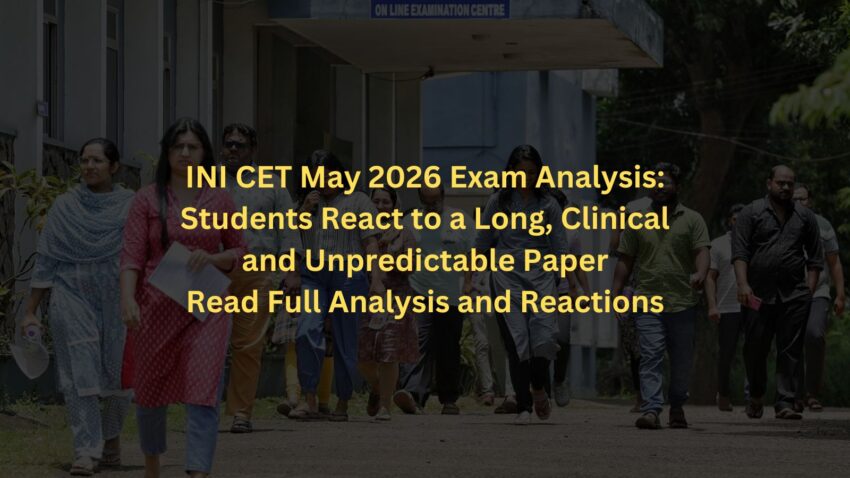
The wait is finally over. After months of preparation, sleepless nights, revision marathons, GT anxiety, and constant comparison with previous papers, thousands of aspirants finally walked out of their examination centres after appearing for the INICET May 2026 examination today.
And if there is one phrase that seems to describe the overall mood among candidates, it is this:
“It was not impossible, but definitely unpredictable.”
The moment students stepped out of the exam centres, Telegram groups, WhatsApp chats, hostel corridors, and social media pages quickly started filling with reactions. Some students looked relieved. Some were visibly disappointed. A few came out confident, while many simply said the same thing:
“I honestly don’t know how it went.”
That itself says a lot about today’s paper.
Although a complete official analysis will take time and memory-based questions are still being discussed among students, early reactions suggest that the INI CET May 2026 paper felt highly conceptual, clinically integrated, and mentally exhausting for many aspirants.
Here is a detailed look at what students are saying and how today’s exam felt from an aspirant’s perspective.
One aspirant who appeared for the exam shared a detailed reaction and felt this paper was very different from the previous attempt:
“PYTs were not asked in the same volume like the last paper. A lot of new topics were explored this time. Even when questions looked straightforward, the options felt twisted and confusing. For example, in a Beta Thalassemia-related question, one option mentioned ‘ineffective erythropoiesis,’ and that wording felt vague in the moment. I personally found multiple-choice options trickier compared to the last INI CET. It felt more like a novel paper rather than a traditionally difficult one. Maybe one year from now, aspirants may find this easier because coaching apps will eventually start covering these topics. Personally, I found the November session easier.”
The Mood Outside Exam Centres: Relief, Confusion and Overthinking
If you have ever appeared for an entrance exam like INICET, you already know that the real discussion starts after the paper ends.
Students usually come out and immediately begin asking:
“What did you mark in that Medicine question?”
“Did Surgery feel weird to you?”
“Was it just me or was PSM unexpectedly tricky?”
Today felt no different.
For many aspirants, the first reaction was not excitement or confidence it was confusion.
Several candidates described the paper as “doable but tricky.” Not because the questions were impossible, but because many options reportedly looked close enough to create doubt.
One student outside a centre described the feeling perfectly:
“The paper was not brutally hard, but it kept making you doubt yourself. Even questions you knew felt confusing.”
Another student preparing for months specifically for this attempt said:
“I expected factual questions, but many felt concept-based. It tested understanding more than memorisation.”
This kind of reaction is not unusual for INI CET. Over the years, the exam has built a reputation for testing clinical thinking rather than pure mugging up.
And today, students once again seemed to feel that pressure.
Was the INI CET May 2026 Paper Easy or Difficult?
This is probably the biggest question everyone wants answered. The honest answer? It depends on who you ask. Based on early student reactions, the paper appears to have fallen somewhere between moderate to difficult, especially for students expecting direct recall-based questions.
Many candidates described the paper as:
- Lengthy
- Clinical
- Conceptual
- Integrated
- Unpredictable
Interestingly, very few students used the word “easy.” Instead, many described the paper as mentally draining because it demanded concentration from beginning to end.
One aspirant shared:
“The difficulty wasn’t because questions were impossible. It was because the exam made you think continuously. No room for careless mistakes.”
Another candidate said:
“I had prepared PYQs heavily, but today’s pattern felt slightly different in terms of presentation.”
This doesn’t necessarily mean the exam was tougher than previous years, but many students felt it required better clinical application and sharper elimination skills.
Subject-Wise Impressions: What Students Felt
Since memory-based discussions are still ongoing, a complete breakdown will take some time. However, based on early reactions, certain trends seem to be emerging.
Medicine: High Weightage, High Thinking
Medicine once again appears to have dominated discussions. Many students reportedly felt that Medicine required conceptual clarity rather than surface-level preparation. Rather than straightforward factual recall, students suggested several questions leaned toward interpretation and clinical understanding.
One aspirant commented:
“Medicine felt manageable if concepts were clear, but guessing was risky.”
Students who had strong clinical preparation generally appeared more comfortable. However, candidates relying mainly on revision notes felt challenged.
Surgery: Slightly Tricky for Some Students
Surgery reactions were mixed. Some candidates found it straightforward, while others believed certain questions were framed in a way that demanded careful reading. A common reaction among students was:
“Not extremely hard, but not very scoring either.”
Several aspirants felt Surgery had moments where two options looked equally correct, increasing confusion.
Obstetrics and Gynecology: Balanced but Selective
Many students described Obstetrics and Gynecology as moderate. Some aspirants expected more predictable patterns but felt surprised by a few concept-oriented questions.
One student said:
“Obs-Gynae wasn’t bad, but it definitely needed proper understanding.”
Students with solid conceptual preparation appeared relatively satisfied.
Pediatrics: Fair but Clinical
Pediatrics reportedly felt balanced for many aspirants. However, several students mentioned that clinical understanding played an important role.
One candidate joked after the exam:
“Pediatrics looked cute until the options appeared.”
That sentence probably captures the post-exam feeling better than anything else.
PSM: Never as Easy as It Looks
Every INI CET attempt has one subject that surprises people. For many students today, that subject may have been Preventive and Social Medicine (PSM). Some aspirants felt PSM questions looked familiar but became confusing because of closely related options.
A candidate explained:
“PSM always gives false confidence. You think it’s easy until you overthink every answer.”
Pathology, Pharmacology and Microbiology
Several students felt these subjects remained important but leaned toward conceptual understanding rather than isolated memory recall. Candidates who revised integrated concepts generally seemed more comfortable.
The Paper Felt Long: A Common Student Complaint
One theme that repeatedly surfaced among early reactions was time pressure. Many students felt the exam was not necessarily impossible but mentally exhausting because of its length and concentration demands.
One aspirant said:
“I completed it, but the last part felt rushed.”
Another commented:
“The challenge wasn’t knowledge alone. Maintaining focus for the entire paper was hard.”
This is important because even moderate questions can become difficult when fatigue sets in. Several candidates admitted they started overthinking in the second half of the exam. And honestly, every INI CET aspirant knows this feeling. You enter confident. Then somewhere in the middle, suddenly every answer feels wrong.
Was INI CET May 2026 Tougher Than Previous Attempts?
This question will remain debated for the next few days. At the moment, early reactions suggest students found this paper:
- More conceptual than expected
- Less directly factual for some subjects
- Moderately difficult overall
- Mentally tiring because of continuous thinking
However, comparisons with previous attempts are always subjective. Students who prefer clinical reasoning may find the paper fair. Students who expected straightforward memory-based questions may disagree. That is why post-exam reactions often feel divided.
Expected Cutoff: Too Early, But Here’s What Students Think
Let’s be honest. Within minutes after every medical entrance exam, people begin asking: “What will be the cutoff?”
The truth is it is still too early for exact predictions. Memory-based recalls, score patterns, and overall performance trends will become clearer over the next few days. However, many aspirants believe that if the paper was genuinely moderate-to-difficult for a large number of students, cutoff inflation may not be dramatic. Still, candidates should avoid panic based on random Telegram claims.
One student wisely said:
“Every year people say paper was impossible, then cutoff surprises everyone.”
That statement is probably worth remembering.
What Students Should Do Next
Now that the exam is over, the most important thing is: Do not emotionally destroy yourself with overanalysis.
- Yes, memory recalls matter.
- Yes, discussions matter.
But obsessively calculating every possible mistake immediately after the exam rarely helps.
Instead:
- Take one day off
- Wait for recall-based analysis
- Review calmly
- Avoid misinformation
- Focus on realistic expectations
The exam is done, You cannot change the bubbles now.
FAQs
Was INI CET May 2026 difficult?
Based on early student reactions, the paper appears to be moderate to difficult, with a stronger focus on concepts and clinical reasoning.
Which subject was toughest in INI CET May 2026?
There is no clear consensus yet, but many students discussed Medicine, PSM, and integrated clinical questions more heavily.
Was INI CET May 2026 lengthy?
Several aspirants described the paper as mentally exhausting and time-consuming, though opinions vary.
When will memory-based questions be available?
Memory-based recalls are expected to emerge gradually over the next 24–48 hours through coaching discussions and student forums.
What is the expected cutoff for INI CET May 2026?
It is too early for accurate predictions. Cutoffs will depend on overall paper difficulty and candidate performance trends.
Hello, I am Dr. Ashish. I have lot of experience in medical field and education, I have gained lot of knowledge in my entrance exam life and medical studies which I want to share with everyone so that I can help more and more people.